Radiesse vs Sculptra: the battle of the non-hyaluronic acid based injectables. We have previously discussed hyaluronic acid (HA) dermal fillers, their benefits, and the differences between Juvederm HA fillers and Restylane HA fillers (the two largest HA filler lines in the US). There are also several other notable HA fillers in the US, such as the RHA family of HA fillers from Teoxane, Belotero from Merz, and Revanesse Versa.
Radiesse and Sculptra are both non-hyaluronic acid based injectable treatments. What are the pros and cons of Radiesse vs Sculptra and which one is better for you?

What is Radiesse?
Radiesse is a dermal filler that is comprised of calcium hydroxyapatite (CaHA) particles suspended in a carboxymethylcellulose gel base. Because of the CaHA particles, Radiesse is characteristically white in color and has a very high G prime. G prime (G’) measures firmness of a dermal filler; high G prime means that the material is relatively firm/stiff, resists deformation, and gives lift and structure. Fillers with these characteristics are good for deep injection in bony areas such as the cheeks, chin, jawline, or nose.d
Read More: What is Radiesse?
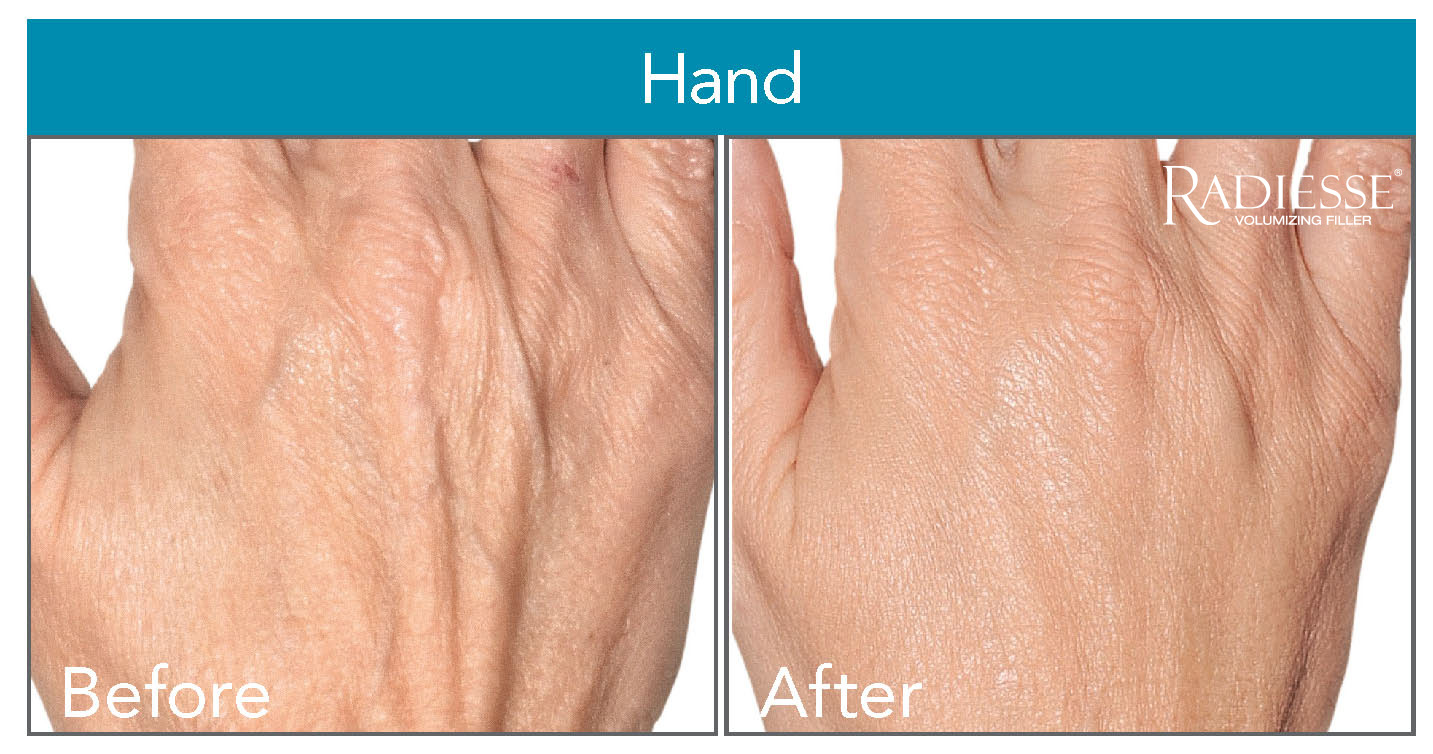
Radiesse can be diluted with saline or mixed with HA fillers for a lower G prime. This can be for treatment of the backs of the hands, injection in soft tissue areas such as the cheeks, periorally (around the mouth), the neck, and even body (e.g. hips, butt, and abdomen). Hyperdiluted Radiesse can be used to help treat acne scars, improve texture of crepey skin, and even stimulate collagen.
Unlike HA dermal fillers, Radiesse is biostimulatory in addition to volumizing. Biostimulatory means that quality of skin can improve due to collagen and elastin stimulation. The gel base of Radiesse provides immediate volumization and lift in the same manner that HA fillers do. Over time, as the carrier gel is absorbed and broken down by the body, the CaHA particles encourage fibroblast stimulation, acting as a physical scaffold for the formation of new collagen and elastin over time. This is why Radiesse provides lift and volumization, but also skin quality improvements as well.
HA fillers are purely volumizing. Injection of HA filler volumizes by way of tenting skin due to the material being injected. HA fillers also tend to absorb water (how much depends on the specific filler used) and swell over the first few days to weeks after injection.
What is Sculptra?
Sculptra is a biostimulatory injectable that is made of PLLA, Poly-L-Lactic Acid. While Sculptra is an injectable treatment, it works different than do HA dermal fillers and Radiesse. The PLLA particles that comprise Sculptra are different sizes and cause an inflammatory response in the skin after injection. This stimulates fibroblast production of new collagen and elastin to firm skin and refresh skin in a subtle and natural way.
Sculptra comes as a powder in a vial and requires reconstitution with sterile water and vigorous shaking before usage. Sculptra treatment requires vigorous massage in injected areas repeated over several days.
Initial recommended treatments with Sculptra is your age divided by ten, but this will depend based on individual skin condition, anatomy, and expectations for treatment.
Read More: What is Sculptra?
The key to understanding Sculptra is that it is NOT volumizing; it is purely biostimulatory. While the build up of new scaffolds of collagen and elastin is subtly volumizing, it is not immediately volumizing like HA filler or Radiesse. There is initial swelling and fullness after treatment because the PLLA needs a diluent (liquid reconstitution component) in order to be injected, but this is absorbed and goes down a day or two after treatment. Sculptra can take up to 90 days to begin to be apparent, and repeated treatment in the same area will create some subtle volumization, but Sculptra is primarily to improve skin quality, reduce some wrinkles, and improve skin laxity.
Sculptra is safe for injection in the lateral face (e.g. temple area, hollows of the cheek) and body, but not as recommended for the medial face (forehead, nose, medial cheek inward, etc.) Advanced injectors may hyperdilute Sculptra and inject in the medial face, but these areas are riskier for treatment due to vasculature and possibility of bumpiness after treatment. Hyperdilute Sculptra can also be used for improvement of acne scarring as well as skin laxity in the neck and body.
How to pick between Radiesse vs Sculptra vs HA filler?
If you’re looking for soft tissue volumization (lips, fine lines), choose HA dermal filler treatment.
If you’re looking for contour and volumization in bony areas such as the jawline, cheeks, chin, or nose, choose HA filler if no skin quality improvement is necessary. Choose Radiesse if the high G prime of Radiesse is more suitable for the injection area (for greater support) or skin quality improvements are desired alongside volumization. Of course, this will depend on individual anatomy and initial starting condition; sometimes deep injection does not provide skin quality benefits because of the depth of injection.
For more superficial injection in soft tissue, Radiesse + HA dermal filler can be mixed and injected together. This is good for when skin quality improvements are desired. Radiesse can also be diluted and injected alone if swelling/migration from HA filler is a concern. This will depend again on treatment area and skin condition.
If you’re looking for correction of age-related volume loss/skin laxity in the lateral face, choose Sculptra. If volume loss is very apparent, then both Sculptra and HA filler can be considered.
If you’re deciding between Sculptra vs Radiesse vs HA filler treatment in San Gabriel, Los Angeles, give DSC a call! Our experienced consultants provide free consultations and can assess your goals and anatomy to give you personalized treatment recommendations.
DSC Laser & Skin Care Center
www.dscbeauty.com
(626)285-0800
info@dscbeauty.com
889 S. San Gabriel Blvd, San Gabriel, CA 91776
