It’s approaching winter, which is a great time to do laser treatments. Because sun exposure plays a critical role in the outcome of a laser treatment, scheduling treatments during the winter months when risk of sun exposure is not as high is key. Understanding how laser treatments work on the skin and what different types of lasers do is super important when it comes to treatment selection. So really, what are laser treatments and what do they do for the skin? What is the difference between all the different types of lasers?
What is laser?
Although laser is a word that has entered the general lexicon, “laser” is actually an acronym that stands for “Light Amplification by Stimulated Emission of Radiation.” According to the National Ignition Facility, “energy from light “excites” electrons in atoms of optical materials and they move to a higher-energy orbit. When the electrons return to their normal orbit spontaneously or when “stimulated” with light or energy, they emit light particles called photons.” These light photons are coherent and monochromatic, which means that they all move in the same direction as the wavelength of light and consist of one wavelength. In contrast, regular household lights are incoherent (moving in many directions) and comprised of many different wavelengths. When it comes to the skin, these unique properties of lasers can be harnessed to create visible and tangible changes, such as pigmentation removal, tattoo pigmentation removal, skin tightening, wrinkle removal, lesion removal, resurfacing, blood vessel removal, hair removal, collagen neogenesis, and much more.
Lasers can induce specific changes in the skin due to selective absorption of light by chromophores in the skin. Chromophores are molecules in the skin that selectively absorb light of different wavelengths, e.g. hemoglobin, melanin, or even water. This property means that a laser’s function is essentially determined by its wavelength. Of course, different properties like pulse duration, treatment area size, % of skin coverage, etc. will affect treatment outcomes, but a laser’s function is generally mainly determined by its wavelength.
What is the wavelength of a laser and what does it do?
“The particular wavelength of light is determined by the amount of energy released when the excited electron drops to a lower orbit. The levels of energy introduced can be tailored to the material in the gain medium to produce the desired beam color” (NIF). While this sounds complicated, all this means is that laser devices utilize different sources and mediums in order to produce photons of a specific wavelength. If you’ve ever seen the terms “Nd:YAG,” “Erbium,” “Alexandrite,” “Ruby,” “CO2,” “Pulsed Dye,” or “IPL,” these are all laser mediums that produce photons of different wavelengths. Depending on the type of medium, these lasers can be classified as solid state (crystal-based), gas, liquid dye, etc.
For example, “Nd:YAG” stands for neodymium-doped yttrium aluminum garnet, a lasing medium compromised of a specific crystal that is a common medium for many lasers. Commonly, Nd:YAG lasers come with wavelengths of 1064nm and 532nm. IPL lasers, or intense pulsed light, use flashlamps (typically xenon) to produce photons somewhere in the range of 500nm to 1200nm, with selective filters used to attain specific wavelengths in the range. Alexandrite lasers use alexandrite crystals as a lasing medium, and a common desirable wavelength is 755nm. Erbium lasers use an erbium-doped yttrium aluminum garnet crystal medium, and typically are a wavelength of 2940nm. For CO2 lasers, CO2 is excited by plasma discharge, which results in a laser with a comparatively longer wavelength, typically somewhere around 10,600nm. This is not an exhaustive list of lasers; there are many other desirable laser wavelengths with various laser mediums.
The shorter a laser’s wavelength, the more likely it is to be in the visible light range spectrum (380nm~700nm). This includes IPL, hair removal, and also some Nd:YAG lasers. Firing the laser results in visible flashes of bright light. Because of this, eye protection is necessary when undergoing treatment, for both the patient as well as the provider. Longer laser wavelengths are in the infrared range and generally not visible to the human eye, although eye protection is still recommended for overall treatment safety. The only light visible with these types of lasers may be an LED guiding light, or some other device-specific indicator for successful passes.
Because lasers are emitted in specific wavelengths, this specificity can be harnessed in order to treat different aspects of the skin. As previously mentioned, chromophores in the skin will selectively absorb certain wavelengths and not others, which is what allows selective targeting of the skin. Therefore, depending on what is being treated, there is an “optimal range” of laser wavelength absorption. Melanin, which is what comprises skin pigmentation, is one such chromophore, while hemoglobin (i.e. redness or visible blood vessels) is another. Different tattoo colors may even require different treatment wavelengths because the pigments also demonstrate selective absorption.
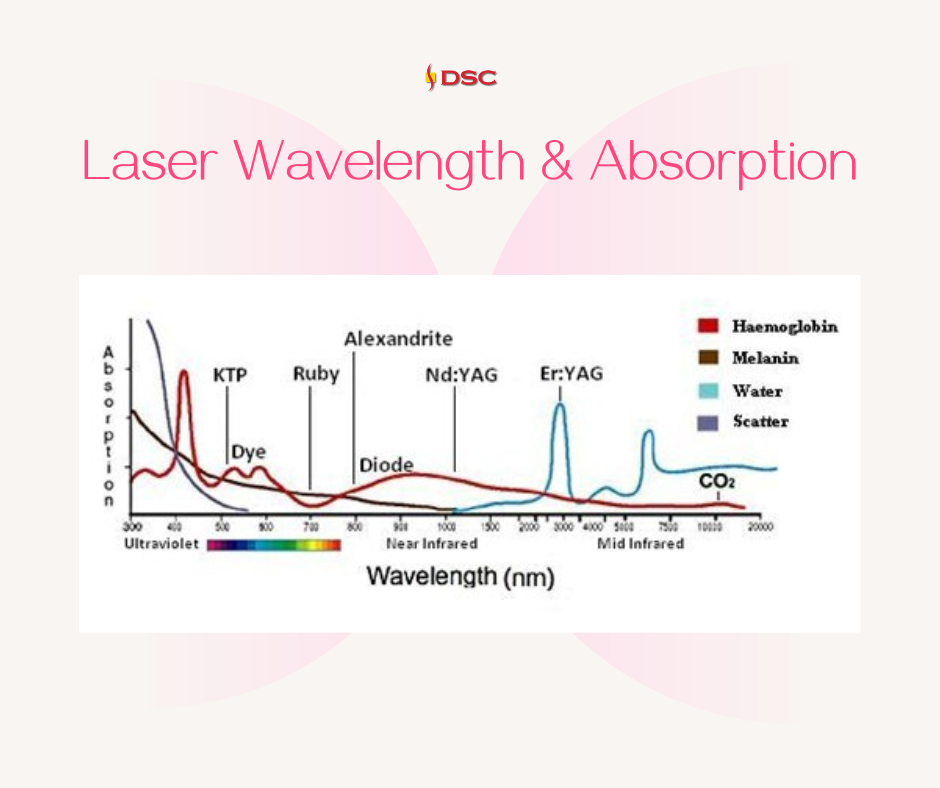
While there are “optimal” wavelength ranges to target specific skin concerns, skin type can and does HIGHLY affect laser treatment outcome. Therefore, while laser wavelengths can be “optimal” theoretically, these “optimal wavelengths” can result in unwanted post-treatment side effects such as hypo- or hyperpigmentation in certain skin types. Thusly, alternative wavelengths, settings, or even treatment types may be recommended depending on individual skin condition and concerns. This is why choosing an experienced provider is very important. A provider who is experienced in treating your skin type and specific skin concerns is just as or even more important than selecting a provider with the latest and greatest devices. New research is constantly being done on optimizing laser treatments, which means in the future that combined treatments or different wavelengths may also prove effective.
Frequently Asked Questions
1. What is a laser and how does it work on the skin?
Laser stands for Light Amplification by Stimulated Emission of Radiation. Unlike regular household light, laser light is coherent and monochromatic, meaning all photons travel in the same direction at a single wavelength. When applied to the skin, this precise energy is selectively absorbed by specific molecules called chromophores, such as melanin, hemoglobin, or water. This selective absorption allows lasers to produce targeted changes in the skin, including pigmentation removal, collagen stimulation, hair removal, blood vessel reduction, and skin resurfacing, without broadly affecting surrounding tissue.
2. What does laser wavelength mean and why does it matter for skin treatment?
A laser’s wavelength is determined by the energy medium used to generate the light, such as Nd:YAG crystals, CO2 gas, or alexandrite crystals. Each wavelength is absorbed preferentially by a different chromophore in the skin, which is what determines what a laser can and cannot treat. For example, shorter wavelengths in the visible light range target melanin and hemoglobin, while longer infrared wavelengths like CO2 at around 10,600nm target water-rich tissue for deep resurfacing. Choosing the right wavelength for your specific concern is one of the most important factors in achieving safe, effective results.
3. What skin concerns can laser treatments address at a clinic in Los Angeles?
Laser treatments can target a wide variety of skin concerns, including pigmentation and sunspots, tattoo removal, wrinkles and fine lines, skin laxity, enlarged pores, acne scarring, visible blood vessels and redness, unwanted hair, and surface texture irregularities. The specific concerns a laser can treat depend on its wavelength and settings, as different wavelengths are absorbed by different targets in the skin. At DSC Laser & Skin Care Center in San Gabriel, an experienced team can assess your skin and recommend the most appropriate laser or combination of lasers for your individual goals.
4. Why is winter the best time to get laser skin treatments in San Gabriel?
Sun exposure before and after laser treatment can significantly affect outcomes, increasing the risk of post-treatment complications such as hyperpigmentation or uneven results. Winter months naturally reduce the likelihood of heavy sun exposure, making it easier to follow the sun avoidance guidelines that are essential for safe and effective laser care. Scheduling treatments during cooler months also gives the skin adequate time to heal and for results to develop before the higher-UV summer season arrives. It is still important to wear daily SPF throughout the process, regardless of the time of year.
5. Does skin type affect which laser treatment is right for me?
Yes, skin type has a significant impact on laser treatment selection and outcomes. Even when a particular wavelength is theoretically optimal for a specific concern, it may carry a higher risk of side effects such as hyperpigmentation or hypopigmentation in certain skin types, particularly darker tones that contain more melanin. This is why an experienced provider may recommend alternative wavelengths, adjusted settings, or entirely different treatment approaches based on your individual skin tone and condition. Choosing a provider with proven experience treating your skin type is just as important as the technology being used.
6. How do I know which type of laser treatment is right for my skin concern in San Gabriel?
The right laser depends on your specific concern, skin type, and treatment goals. Different laser mediums produce different wavelengths that selectively target melanin, hemoglobin, water, or tattoo pigments, so there is no universal answer. Factors like pulse duration, treatment coverage, and your skin’s individual response all play a role in determining the safest and most effective approach. Consulting with an experienced provider at DSC Laser & Skin Care Center in San Gabriel is the best first step, as a personalized assessment will account for your unique skin history and help match you to the most appropriate treatment plan.
For inquiries or consultations on laser treatments in Los Angeles, please give DSC a call! We have an experienced team of providers and consultants who are happy to address your individual concerns.
DSC Laser & Skin Care Center
www.dscbeauty.com
(626)285-0800
info@dscbeauty.com
889 S. San Gabriel Blvd. San Gabriel, CA 91776