XERF vs Ultherapy – which is better?
We have previously compared XERF to Thermage as they are both monopolar, radiofrequency-based, skin-tightening treatments. Each has its pros and cons, so click to read our previous blog post comparing the two for a head to head comparison of RF skin treatments.
Read More: XERF vs Thermage
You may have heard that XERF uniquely features dual frequency radiofrequency, which allows it to treat up to the SMAS layer of the skin. Ultherapy and Ultherapy PRIME are also able to treat down to the SMAS as well. SMAS stands for Superficial Musculoaponeurotic System. The SMAS is a layer of tissue positioned directly under the skin and subcutaneous fat and right above the deeper facial muscles. It is made of a thin mix of fibrous connective tissue, collagen, and muscle fibers and anchors the skin to the underlying facial muscles. The SMAS is notable because this is a layer that surgeons often target in certain types of surgical face and neck lift procedures.
If both XERF and Ultherapy PRIME can treat down to the SMAS, you may be wonder: which is better? The answer: it’s not so simple.
Even though these two treatments can treat up to the same depth in the skin, their mechanisms of action differ so they have different outcomes. Understanding how each treatment works on the skin is key to determining which treatment is better for your skin.
How does XERF work?
Xerf is a non-invasive, radiofrequency (RF) -based, skin tightening treatment. RF skin treatments can help tighten, contour, and remodel skin by tightening existing collagen and jumpstarting the process of neocollagenesis. All RF treatments that tighten the skin do so by targeting water molecules in the skin and oscillating them rapidly, creating heat that causes immediate contraction and triggers new collagen prodution. The more hydrated the skin, the better the result. Drinking sufficient water before and after RF skin treatments helps improve outcomes.
XERF is also notably a monopolar RF treatment, similar to Thermage, Oligio, X-Therma, and various other skin treatments worldwide. RF energy flows from a postive pole to a negative pole. Monopolar RF means that the RF energy enters the skin via the device handpiece (the positive pole), and passes out of the body via a grounding pad (the negative pole) that is generally stuck on the back or thigh and returned back to the device. This allows deep penetration of RF energy into the skin for meaningful skin contraction and collagen remodelling without needles or any other sort of invasive entry into the skin.
Treatments with monopolar RF generally feature flat tips that are stamped/glided over the skin in a grid-like pattern to deliver energy to treatment areas. This DOES mean that monopolar RF treatments are contraindicated for those with pacemakers, those with implantable battery-powered devices, and those with certain metal-based surgical implants.
In contrast, bipolar and multipolar RF skin treatment devices feature positive and negative poles both on the handpiece or very close together. This does not require RF energy to flow through the body to a grounding pad; instead, RF energy arcs from positive pole to negative pole for bipolar RF, or between multiple + and – poles for mutipolar RF. The distance that RF energy can travel in bipolar or multipolar configurations is limited, which is why many RF microneedling devices and home RF skin devices are designed with bipolar or multipolar RF arrays. The former requires skin penetration via needles to bring RF energy to the suitable depth for skin remodelling, the latter for safety in home use situations.
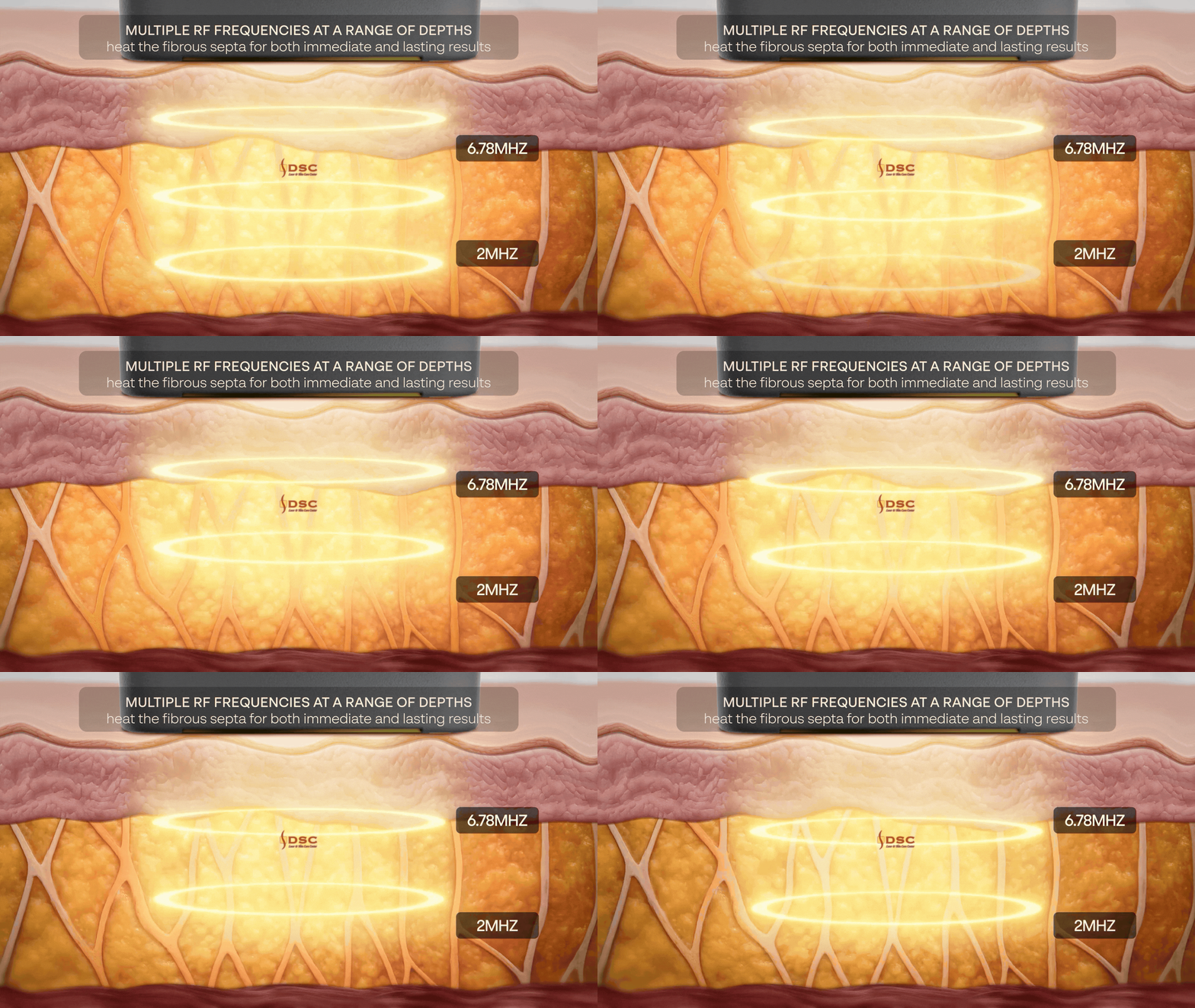
XERF’s unique feature is its dual RF frequency energy delivery. Most other RF skin treatment devices feature only 6.8 MHz RF, which is suitable for overall skin tightening and remodelling. In deep mode, XERF features a secondary 2.0 MHz RF, which brings overall RF energy deeper into the skin via the fibrous septa up to the SMAS layer. Because XERF targets water as a RF-based treatment, adipose tissue is preserved and not damaged. There is little water in adipose cells compared to other tissue; XERF helps reorganize collagen and elastin, jumpstart production of collagen, and improve ECM (extracellular matrix).
How does Ultherapy work?
Ultherapy and Ultherapy PRIME are micro-focused ultrasound treatments. HIFU treatments and Sofwave are other examples of ultrasound-based skin tightening treatments that are on the market. Ultrasound skin treatments work by using high-energy ultrasound waves to target tissue at certain depths in the skin. Concentrating ultrasound in tissue creates heat for fractions of a second and causes localized thermal coagulation. This triggers the wound-healing response in the skin, tightening existing collagen and kickstarting new collagen production. Ultherapy is unique among ultrasound-based skin treatments because it features real-time skin visualization, much like ultrasound scans for the body.
Typically, ultrasound-based skin tightening treatments treat at various depths in the skin – 1.5mm, 3.0mm, and 4.5mm; the surface of the skin is completely avoided. These different depths are generally targeted with interchangeable handpieces or transducers. Notably Sofwave ONLY targets 1.5mm depth; most other ultrasound skin treatments can target all three depths. 1.5mm depth is mid-dermis and a good depth for all over collagen production, targeting deeper depths like 3.0mm and 4.5mm provide more intensive tightening and lifting.
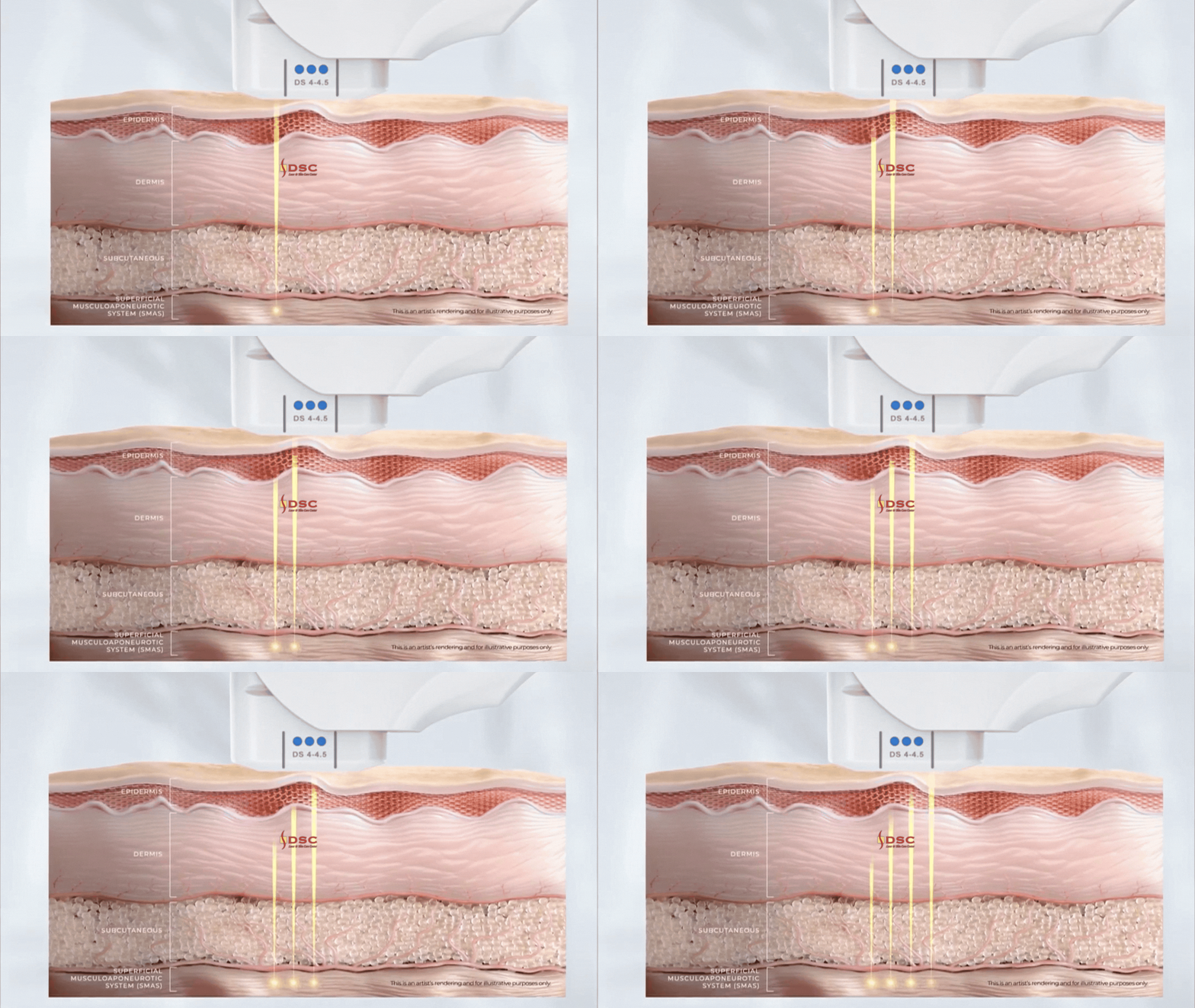
Treatment area and invidual anatomy determine depth of treatment. For example, the forehead is comprised of thin tissue over bone; treating 4.5mm depth in the forehead would only be right on the bone, causing discomfort with no skin benefit. In contrast, thick tissue like in the lower face and submental areas can be treated with 4.5mm due to abundant tissue volume. Each individual is different; scanning in real time allows visualization of collagen-rich areas to target.
Improper Ultherapy and HIFU treatment technique CAN melt fat. This is why the real-time skin visualization in Ultherapy and Ultherapy PRIME is so important – the various tissue types can be visualized and providers can accurately target collagen-rich areas while avoiding fat and bone. Ultrasound skin treatments can be used off-label to reduce facial bulk for those with excessive facial volume, but this is an unusual outcome and most people desire lift and tightening without reduction of facial volume. Understanding facial anatomy is crucial to providing good treatment results; an ultrasound skin treatment is only as good as the provider.
XERF vs Ultherapy
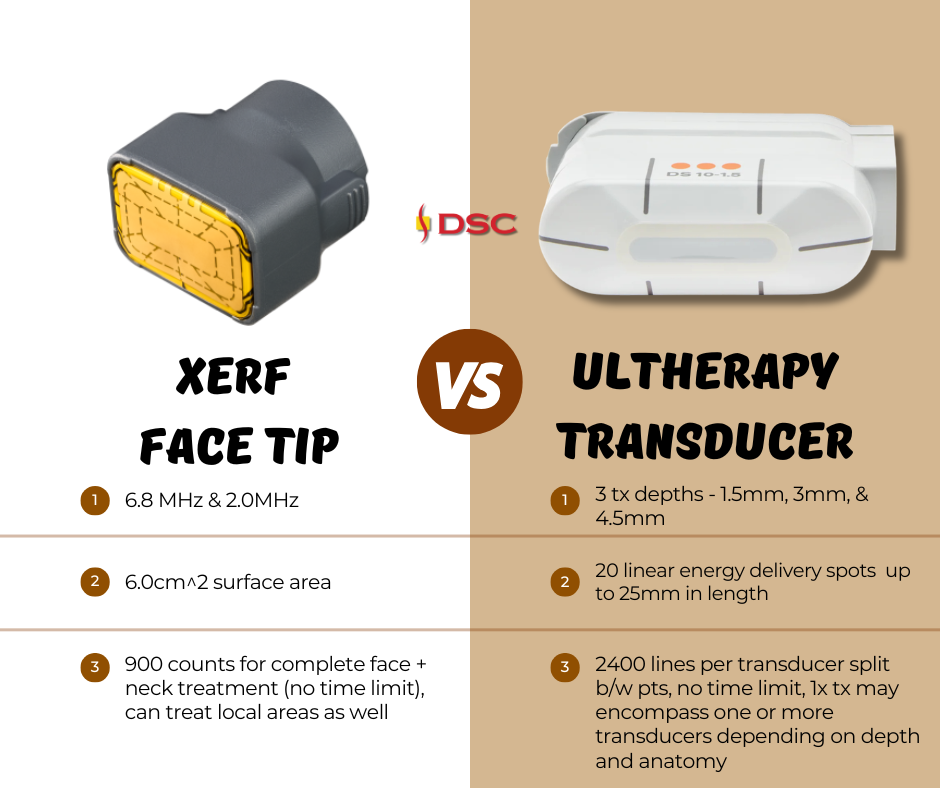
So, if you’re choosing between XERF vs Ultherapy, XERF is slow delivery of monopolar RF energy meant for overall skin tightening and superficial skin texture. Choose XERF if skin is more crepey and you are concerned about preserving facial volume.
If RF treatments are contraindicated, Ultherapy, Ultherapy PRIME, and other HIFU treatments may be suitable options for non-invasive skin-tightening treatments.
Choose Ultherapy, Ultherapy PRIME, and other HIFU treatments if BOTH laxity and volume are concerns.
For more significant skin improvement, do both XERF AND Ultherapy!
For Ultherapy PRIME and XERF treatment in San Gabriel, Los Angeles, give DSC a call! We have over twenty-one years of experience as your friendly, neighborhood, Dr-led aesthetic treatment provider!
DSC Laser & Skin Care Center
www.dscbeauty.com
(626)285-0800
info@dscbeauty.com
889 S. San Gabriel Blvd, San Gabriel, CA 91776
