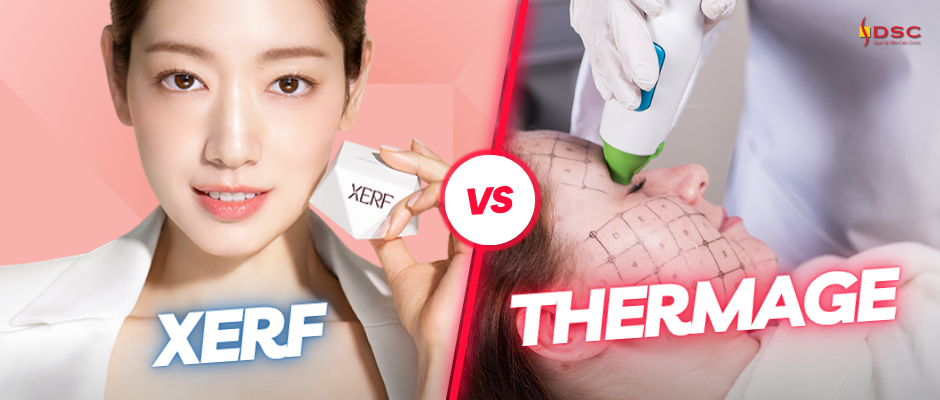
What is the difference between XERF and Thermage? Which one is better for you? XERF is the latest FDA-approved, non-invasive, monopolar, radiofrequency (RF) skin-tightening treatment to hit the US market and it’s taking the aesthetic world by storm. At DSC, we are a diamond-level Thermage provider and have provided Thermage treatments since the first-gen device, so we are very familiar with Thermage and what it can do for the skin. Let’s elaborate on the similarities and differences between XERF and Thermage.
Similarities between both XERF and Thermage
First, let’s go over the similarities between XERF and Thermage. Both are non-invasive, monopolar RF skin-tightening treatments, which makes them seem quite similar. Monopolar RF delivery means that RF energy is delivered by the device handpiece into the skin, and the energy is returned back to the device via a grounding pad that is generally stuck on the back or thigh. Monopolar RF necessitates this design to allow for deep enough energy penetration without damaging the skin.
Compare this with radiofrequency microneedling devices, which generally feature bipolar or multipolar RF delivery mechanisms, where the RF energy is delivered from and returned back into the device via handpiece directly. This energy travels in an arc or parabolic path, which limits distance of energy delivery away from the device. Because there is puncturing of the skin with microneedling, energy can be delivered to appropriate depths by adjusting needle penetration depth. This allows for energy delivery even with a self limiting delivery method like bipolar or multipolar RF.
Because of the monopolar nature of Thermage and XERF and the way energy must pass through the body, individuals with pacemakers are NOT candidates for either treatment. While bipolar and multipolar RF treatments are safer, consult with a doctor before undergoing those treatments or consider non-RF skin treatments like Ultherapy or laser.
Both XERF and Thermage feature one-time-use, flat, treatment tips which are placed on the skin with some sort of water-based gel or fluid to improve energy delivery. The tip is moved in grid-like patterns across the treatment area to ensure even coverage during treatment. Energy can be delivered while the tip is held still or slowly sliding along the skin, depending on treatment comfort levels and desired effect. Both have integrated cryogen cooling on the device tips to ensure treatment comfort.
Differences between XERF and Thermage
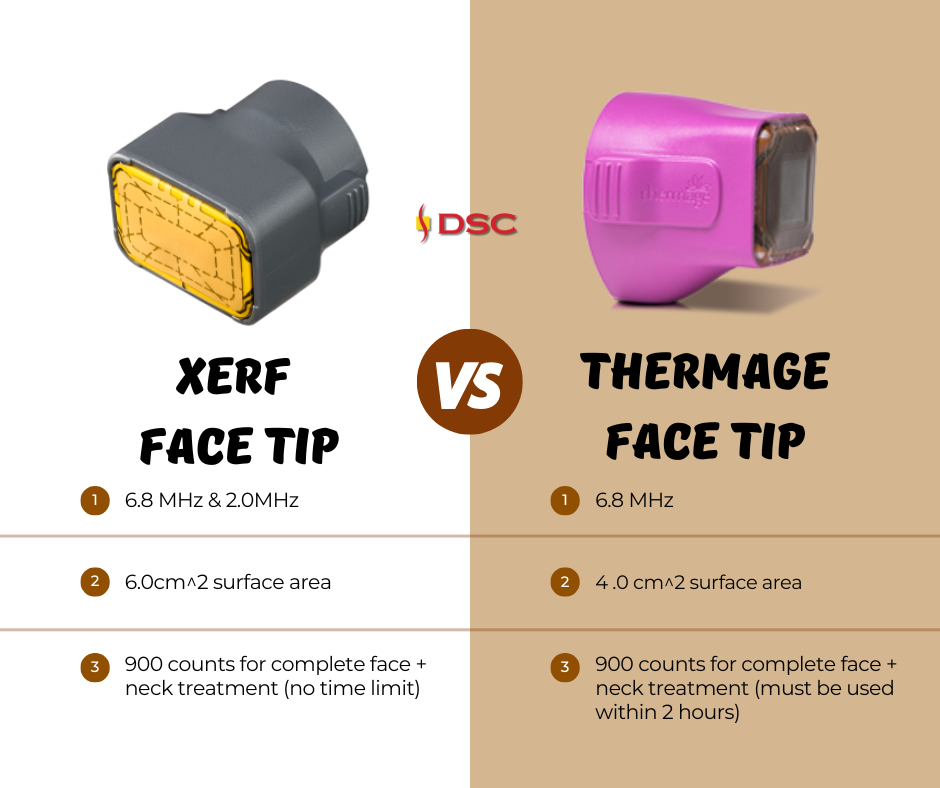
The greatest difference between XERF and Thermage is that XERF features dual frequency RF energy. Both Thermage and XERF feature 6.78 MHz RF energy; however, XERF has a second RF frequency of 2 MHz in “deep mode” that travels down the fibrous septa in the skin to bring the RF energy deeper. This allows for energy penetration up to the SMAS, which makes XERF a bit more akin to an Ultherapy treatment, and is appropriate for treating the lower face. In deep mode, XERF can help treat loose tissue in the lower face, jowls, and submentum. In “medium mode,” XERF can help tighten sagging skin on the mid-face and neck. Lastly, in “shallow mode,” XERF helps restore firmness by improving collagen and elastin thickness and strength (great for upper face: forehead and temple areas).
As of writing (April 2026), XERF does not yet have an FDA-approved tip for treatment of the mobile eyelid, while Thermage has several treatment tip sizes available. XERF has been available on the international market for over a year as of early 2026, so different treatment tips will eventually become available as FDA-approval is obtained. Currently, the only XERF treatment tip available in the USA is a 3cm x 2cm rectangular treatment tip. Eventually, a smaller eye tip and other tips will most likely be approved by the FDA (based on what’s available internationally).
Thermage has a square face tip, a smaller eye tip, and a larger body tip (akin to 4 square face tips put together). These tips are available with various pulses. In general, standard Thermage face tips feature 900 counts, standard eye tips feature 450 counts, and standard body tips feature 500 counts. There are Thermage tips that have 1200 counts, 225 counts, 600 counts, etc. and availability will depend on the stock of each individual clinic. An important feature of Thermage is that once a tip is inserted into the device and energy is delivered once, the entire tip must be used within ~2 hours. This is regardless of if all counts are delivered or not, which means that an entire tip MUST be used in one sitting.
Per shot, RF energy delivery differs between XERF and Thermage. For Thermage, 5 identical microbursts of RF energy are delivered per shot. Cryogen cooling is delivered before, during the 2nd and 4th microbursts, as well as after the 5 microbursts. XERF features 12 microbursts of RF energy that vary in intensity (wave fit pattern). Cryogen is simultaneously delivered alongside the 12 RF microbursts to extend cooling time.
Which treatment is right for me between XERF and Thermage?
If you have more pronounced sagging or laxity in the lower face and submentum, then XERF may be a better choice for you. This is due to the dual frequency energy delivery that brings energy deeper into the skin for an enhanced contouring effect. If you are looking to treat the eyelids, Thermage is still the only FDA-approved, non-invasive RF treatment that can treat the mobile eyelids.
For XERF or Thermage treatments in Los Angeles, give DSC a call! Our dedicated consultants can give you personalized, complimentary recommendations on which treatment is better for you.
DSC Laser & Skin Care Center
www.dscbeauty.com
(626)285-0800
info@dscbeauty.com
889 S. San Gabriel Blvd, San Gabriel, CA 91776
