
What exactly is a Pico Laser? How is a Pico laser different from other lasers? How does a Pico laser work? As one of the most sought-after laser treatments of the last decade, Pico laser treatments seem to still be shrouded in confusion. Pico lasers seem to promise to be able to treat a variety of skin concerns, but is the hype too good to be true? Here’s a 101 guide on Pico Lasers and what they do.
What is a Pico laser?
A Pico laser (short for picosecond) is any laser that can deliver laser energy in increments of picoseconds (1×10^-12 seconds), or trillionths of a second. Most widely available lasers deliver energy in increments of nanoseconds (1×10^-9 seconds), which is billionths of a second. The time that a laser pulse lasts is known as pulse duration. The shorter the pulse duration, the less time skin is exposed to heat (as a side effect of exposure to laser energy). Too much heat applied to the skin during laser is what leads to unwanted side effects like hyperpigmentation, burns, blisters, or even hypopigmentation. Therefore, treatment with a picosecond laser has less risk of negative side effects than treatment with a nanosecond laser. This is especially true for darker skin types (IV, V, VI) that are more prone to hyperpigmentation and post-treatment hyperpigmentation.
How is a Pico laser different from a nanosecond laser?
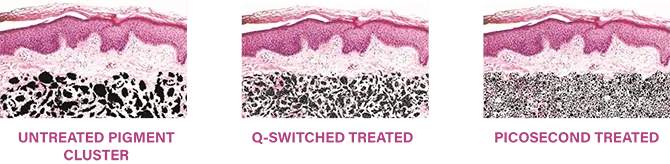
Nanosecond lasers and picosecond lasers have different mechanisms of action as related to pulse duration. Nanosecond lasers primarily rely on photothermolysis to be effective. Photothermolysis occurs when selective absorption of laser light energy induces heat-derived breakdown or vaporization of certain tissues. Meanwhile, Pico lasers utilize photomechanical or photoacoustic effects to be effective. Photomechanical effect occurs when the laser power is concentrated into an extremely short time frame, causing the tissue temperature to change so quickly that an acoustic shockwave is formed. The shockwave overcomes the tensile strength of the tissue, breaking it down mechanically. Because laser light is selectively absorbed, surrounding tissue is spared from excessive heat exposure. While the photoacoustic effect is exclusive to Pico lasers, they can also be operated in nanosecond settings depending on desired outcome. This is because some fluences or specific settings may only be achievable in a nanosecond setting due to specific laser device limitations.
What is the difference between different Pico lasers?
Comparing different Pico lasers is like comparing different car models. Each specific one will have specs that may be preferential to different providers. There are several FDA-approved Pico lasers in the US. The first ever FDA-approved Pico laser was the PicoSure laser from Cynosure. This was followed by the PicoWay laser from Candela. Discovery Pico from Quanta is another popular FDA-approved Pico laser. 2024 saw the advent of an updated Pico laser from Cynosure, the PicoSure Pro. With each successive year, more devices enter the market in the US as well as internationally. Different Pico lasers will differ in available settings and wavelengths. The general wavelengths offered by most Pico lasers are 1064nm and 532nm, with additional wavelengths differing between each laser. For example, PicoSure and PicoSure Pro additionally offer 755nm wavelength, while Discovery Pico offers an additional 694nm wavelength.
When it comes down to the nitty gritty, individual treatment settings and provider experience is much more important than the type of Pico device. Unless the device offers a treatment for a specific skin condition or treatment for specialized tattoo ink color, choosing an experienced provider is much more important than choosing the specific Pico laser device.
When to choose a Pico laser over other lasers?
The wavelength of a laser determines its specific uses and functions. Therefore, Pico lasers are only objectively comparable to other lasers with the same wavelengths. Keep in mind, similar end results can be achieved via many different treatment pathways and combinations. At the end of the day, the “best” laser treatment will depend on skin type, expectations for treatment, initial skin condition, time frame, provider skill, provider access to devices, and many other factors.
Laser tattoo removal is preferential with a picosecond laser. The pigment is broken up more quickly and therefore less treatment sessions are required than treatments with a nanosecond laser. Furthermore, depending on the device model, some picosecond lasers are more effective at treating multi-color tattoos (bright inks like blues and greens are traditionally more difficult to remove).
See More: Tattoo Removal with Pico Laser
For similar reasons, Pico lasers are preferential for treatment of birthmarks such as Nevus of Ota.
If 1064nm treatment of rhytids (wrinkles), enlarged pores, acne scarring, or scar revision is called for, especially in darker skin types, Pico laser is preferential over nanosecond lasers like Q-Switch 1064nm lasers. By keeping full power but concentrating the laser into a fractionated setting, a Pico laser can induce LIOBs (light induced optical breakdown), which is the creation of plasma vacuoles that
Pico lasers are also ideal for non-ablative laser toning treatments. Pico laser toning can also help fade post-inflammatory hyperpigmentation in certain cases.
The best laser to treatment pigmentation and other pigmented lesions will depend on the type of pigmentation and individual’s skin type. Freckles, age spots, other types of sunspots can be treated with Pico lasers. Melasma pigmentation treatment varies on a case by case basis. Depending on pigmentation presentation, certain individuals are not good candidates for Pico lasers and can be better treated by nanosecond lasers, by other lasers with different wavelengths, or even with non-laser therapies. Alternating or combination treatments may also be beneficial. For individual treatment plans, consult your provider.
Read More: Applications of LaseMD Ultra
For Pico laser treatments for tattoo removal, Nevus of Ota, enlarged pores, acne scarring, hyperpigmentation, and pigmentation in Los Angeles, please give DSC a call! Laser treatments are highly individualized and our trained consultants are happy discuss treatment options. Whether it be for Pico laser treatments, other laser treatments, or a combination of Pico and other lasers together, DSC can create an treatment plan tailored to you!
Frequently Asked Questions
1. What is a Pico laser and how does it work on the skin?
A Pico laser is any laser that delivers energy in picoseconds, or trillionths of a second, which is 1,000 times shorter than traditional nanosecond lasers. This ultra-short pulse duration means the skin is exposed to far less heat, reducing the risk of burns, hyperpigmentation, or blistering. Instead of relying on heat to break down tissue, Pico lasers create a photoacoustic shockwave that shatters pigment and stimulates collagen mechanically, making treatments safer and more precise.
2. Why is a Pico laser safer than a regular nanosecond laser for darker skin tones?
Darker skin tones (types IV, V, and VI) are more prone to post-treatment hyperpigmentation because they absorb more heat during laser treatments. Pico lasers significantly reduce this risk by shortening the pulse duration, which limits heat exposure to surrounding tissue. The photoacoustic mechanism targets pigment directly without the thermal side effects associated with nanosecond lasers, making Pico laser a far more suitable option for patients with deeper skin tones who want treatments for scarring, pigmentation, or skin toning.
3. Is Pico laser the best option for tattoo removal in Los Angeles?
Pico laser is widely considered the preferred choice for tattoo removal because its photoacoustic energy shatters ink pigment into finer particles more efficiently than nanosecond lasers, which typically require more sessions to achieve comparable results. Some Pico laser devices are also better equipped to treat multi-color tattoos, including difficult-to-remove blues and greens. At DSC Laser & Skin Care Center in San Gabriel, trained consultants can assess your tattoo and recommend the most effective device and treatment plan for your specific ink colors and skin type.
4. What skin concerns can Pico laser treat beyond tattoo removal?
Pico laser is effective for a broad range of concerns, including acne scarring, enlarged pores, wrinkles, birthmarks such as Nevus of Ota, post-inflammatory hyperpigmentation, freckles, age spots, and general skin toning. In fractionated settings, the laser induces plasma vacuoles that stimulate collagen production for scar revision and texture improvement. For pigmentation conditions like melasma, suitability varies case by case, and a consultation is recommended to determine whether Pico laser or an alternative treatment is the better fit.
5. Does it matter which Pico laser device my provider uses?
While different Pico lasers such as PicoSure Pro, PicoWay, and Discovery Pico vary in wavelengths and available settings, provider experience and individual treatment settings matter far more than the specific device in most cases. The exception is when a particular device offers a wavelength needed for a specialized skin condition or a specific tattoo ink color. Choosing a clinic with a skilled, experienced provider who can tailor settings to your skin type and goals will have a greater impact on your results than the brand of laser alone.
6. How do I know if Pico laser treatment in San Gabriel is right for my pigmentation?
Pico laser works well for many types of pigmentation including sunspots, freckles, and age spots, but it is not universally the best choice for every condition. Melasma, for example, requires a case-by-case assessment, as some presentations respond better to nanosecond lasers, different wavelengths, or non-laser therapies. A consultation at DSC Laser & Skin Care Center in San Gabriel will allow an experienced provider to evaluate your skin type, pigmentation pattern, and treatment history to recommend the most appropriate approach, whether that is Pico laser alone or a combination plan.
DSC Laser & Skin Care Center
www.dscbeauty.com
(626)285-0800
info@dscbeauty.com
889 S. San Gabriel Blvd. San Gabriel, CA 91776